The art of
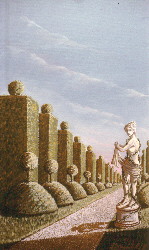
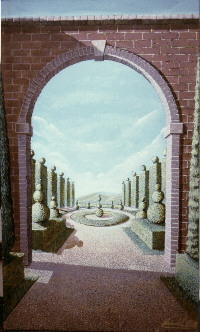
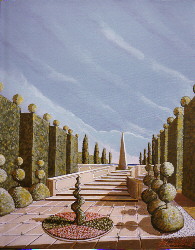
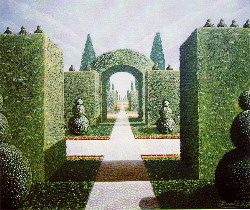
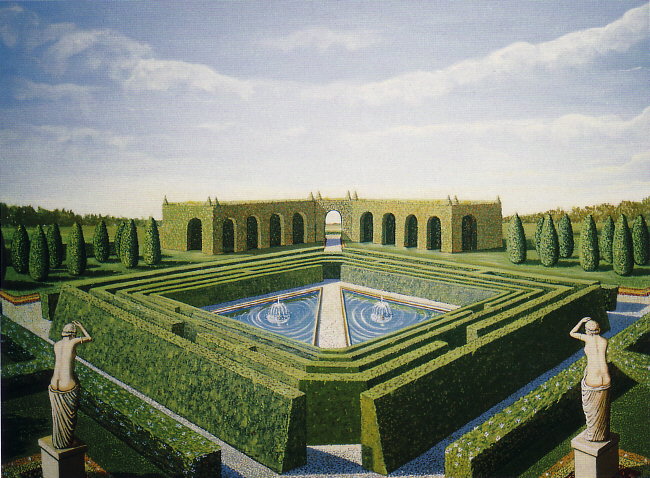
"Topiaria" consists nowadays in tracing and developing, following
strict rules, precises hedges and trees in those fantastic and geometric
shapes that were expression of order and formal integrity in the greek
and roman world.
A technique
that in the Middle Ages has been maintained alive only in the ancient monasteries
and tha was rediscovered during the Renaissance, when with an essential
style myrtle, yew-tree, laurel and box thickets and hedges were elaborated.
In the big
gardens the magnificence was celebrated while intimacy prevailed in the
smaller ones.
A fashion
extended through all the Europe, from Italy to Spain and from Holland to
France. When in 1924 in Paris Breton wrote the "first surrealist manifest"
he exasperated an artistic vision of the life against the static tradition
and was inspired by the newborn psycology theories elaborated by Freud.
In the same period the big labyrint gardens were built almost as they were
a representation of the tough and meandering way of the man toward the
absolute truth. A hidden place for love encounters such as the ones at
the Castles of Woodstock in England and Shonbreunn in Vienna.
Art acts
in the toal freedom of existing and expressing reaching the apex through
that fantastic and supernatural state exaltated by the poet Apollinaire.
I think that
a fixed point of cohesion, a sealing, with what has been and the new Maurizio
Brambilla's works, realizes in the scission between reality an the
oneiric world through the rigour of a surrealistic representation of the
natural interior structure of the man.
While Salvador
Dalì materialized in his more significative works the "dream", Brambilla
expresses through his geometrical gardens or the primeval enigma
or symbolic ideograms of labyrints a natural order where today's
man can find harmony and consolation.
This
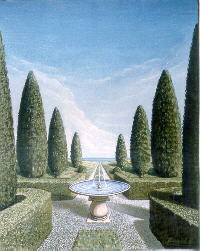
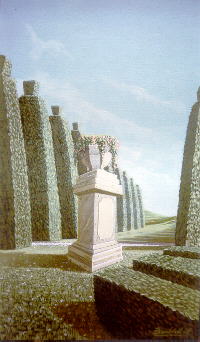
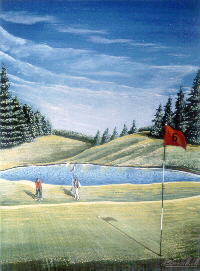
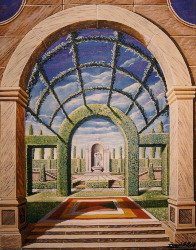
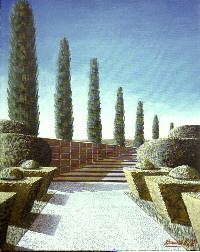
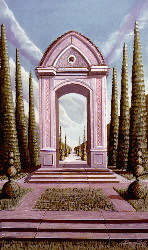
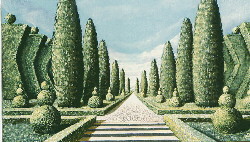
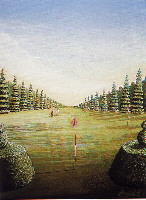
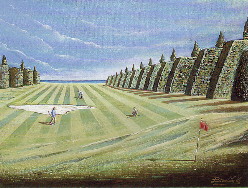
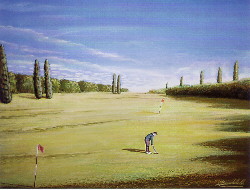
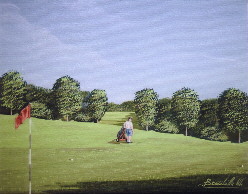
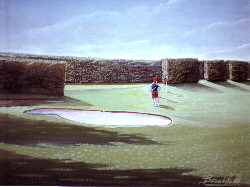
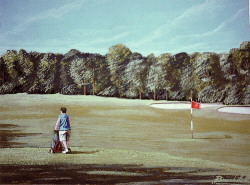
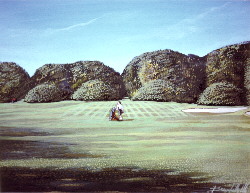
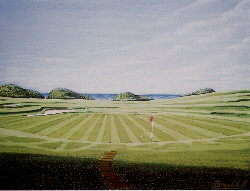
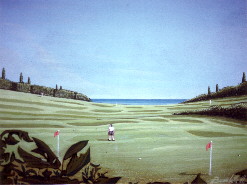
is clear from works such as "Topiaria" , "Green" and others where the nature
is rendered harmonious for the game of Golf. The search for wide spaces,
linearity and semplicity in the wide golf meadows built for playing.
The experience
at "Accademia di Brera" and as shenographer at "Teatro la Scala di Milano"
have been two fundamental hinges of the cultural path for the formation
of a young lombard artist.
What dominated
in his latest works is the relationship between real image and imagination
which highlits visible realities and path of collective cross. Figurative
vibrations originated from landscape memories are expressed with omogeneous
and well equilibrated chromatism.
It is the
new figurativesurrealism of Maurizio Brambilla with aspects of interior
realism interpreted skillfully in a naturalistic form.
An ambitious
target achieved through the complex search between his own es and art by
one of the most coherent and interesting contemporary artists in the italian
and european outline.
Giuseppe
Patellaro Directeur
des Operations Editoriale International passport.
Maurizio
Brambilla PAINTINGS
GALLERY "CLIK"
on images to view them in full size.
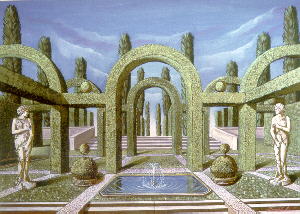
"Le due veneri nel giardino" 70X50 - 1999
oil and acrylic on canvas
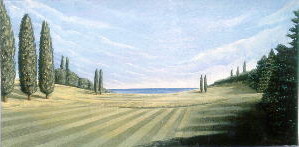
"Pensando al Golf"
60X30 - 2000
oil and acrylic on canvas
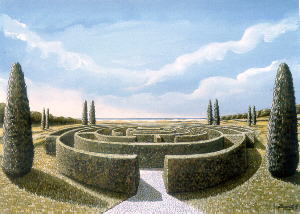
"Labirinto" Cammino dell'Uomo verso la Verità
70X50 - 2000
oil and acrylic on canvas
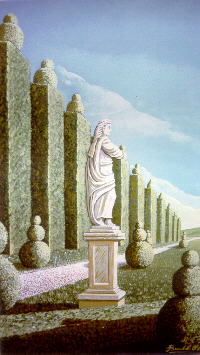
"Topiaria" 30x50 - 2000
oil and acrylic on canvas
"Spazi e Mare" 40x50 - 2000
oil and acrylic on canvas
"Siepi nel Giardino" 30x50 - 2000
oil and acrylic on canvas
"Green Alpino" 30x40 - 2000
oil and acrylic on canvas
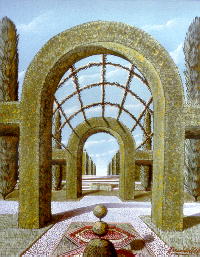
"Archi della Fantasia" 40x50 - 1999
oil and acrylic on canvas
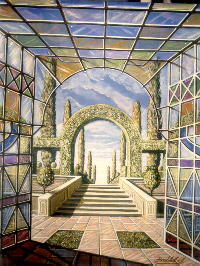
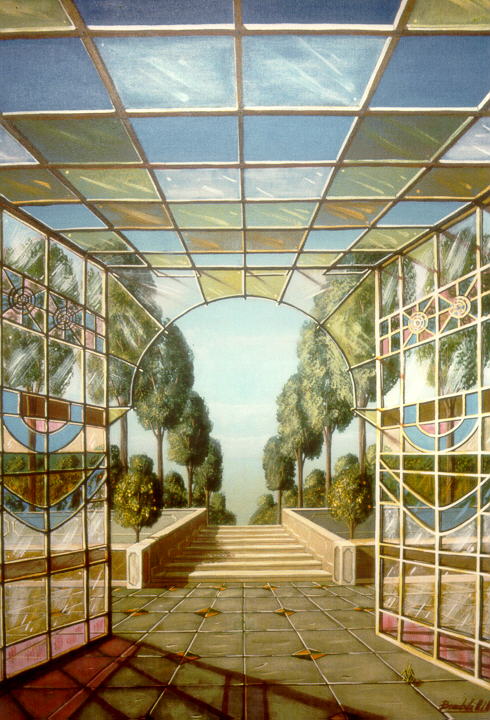
"Architettura con Gazebo" 40x50 1997
oil and acrylic on canvas
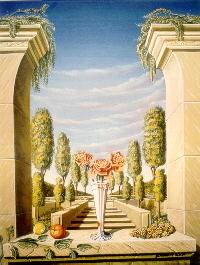
"Architettura con Rose" 40x50 1995
oil and acrylic on canvas
"Gazebo dei Sogni" 50x70 1989
oil and acrylic on canvas
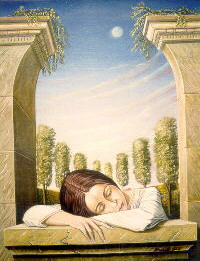
"Il Sonno di Dona" 40x50 1995
oil and acrylic on canvas
"Illusione teatrale" 40x50 1996
oil and acrylic on canvas
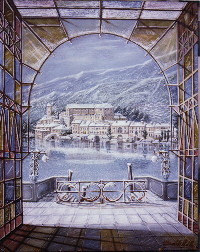
"Isola di San Giulio" 40x50 1997
oil and acrylic on canvas
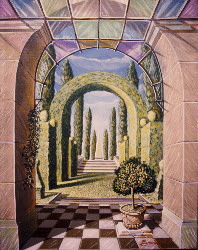
"Architettura con giardino" 40x50 1998
oil and acrylic on canvas
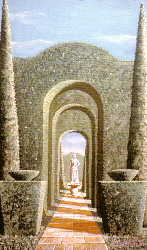
"Viale della topiaria" 30x50 1999
oil and acrylic on canvas
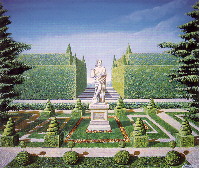
"Venere nel giardino" 30x50 1999
oil and acrylic on canvas
"Geometrie nel giardino" 30x50 1999
oil and acrylic on canvas
"L'alba sulla topiaria" 40x50 1999
oil and acrylic on canvas
"Geometria e simmetria" 40x50 1999
oil and acrylic on canvas
"Architettura con topiaria" 30x50 1999
oil and acrylic on canvas
"Giardino della topiaria" 30x50 2000
oil and acrylic on canvas
"Topiaria e green " 30x40 2000
oil and acrylic on canvas
"La Venere del lago" 60x50 2001
oil and acrylic on canvas
"Topiaria e green" 40x30 2000
oil and acrylic on canvas
"Giocatore di Golf" 40x30 2000
oil and acrylic on canvas
"Presenze nella topiaria" 60x50 2001
oil and acrylic on canvas
"Giocatore di Golf" 30x24 2001
oil and acrylic on canvas
"Giocatore di Golf" 30x24 2001
oil and acrylic on canvas
"Giocatrice di Golf" 30x24 2001
oil and acrylic on canvas
"Giocatore di Golf" 30x24 2001
oil and acrylic on canvas
"Green mediterraneo" 30x24 2001
oil and acrylic on canvas
"Giocatore di Golf" 30x24 2001
oil and acrylic on canvas
"Labirinto: cammino dell'uomo verso la verità" 80x60 2001
oil and acrylic on canvas
MAURIZIO
BRAMBILLA
Painter and
professional scenographer Maurizio Brambilla was born in Milan in 1952.
He got a diploma at the "Beato Angelico" Institute of Milan, then
in 1975 he graduated as "scenographer and custumer" at the "Accademia
di belle Arti di Brera" under professord Varisco's and Purificato's
direction. He has prepared personal art exhibitions in Cagliari, Savona,
Milan, Bordighera, Legnano, Muggiò, Valle Crosia etc... He has taken
part to several manifestations and ghaterings, receiving awards and
recognitions. In scenographical field he has signed scenes and customs
in many theatres, lyric corporations and for the state's TV channel
RAI on Milan. Several art reviewers wrote about him. Amongst them: Bottoni,
Bramato, Carbè, Ciardi, Duprè, Congiu, Franza, Isotta, Martelli,
Nicosia, Sala, Villani, and many others. Since 1982 he is examiner
supervisor for scenography courses at "Accademia di Brera" in Milan.
REFERENCE
ART GALLERIES
Art
Gallery Gelmi - Sesto S. Giovanni
Art
Gallery Eustachi - Milano
MOSTE
RECENTS EXIBITIONS AND AWARDS
ONE
MAN SHOWS
1974 - Art
Gallery "Lelli" Cagliari, presented by Giuseppe Congiù
1975 - Art
Gallery "Lelli" Cagliari, presented by Giuseppe Congiù
1977 - Art
Gallery "Pedrani" Legnano, presented by Lucio Martelli
1977 - Art
Gallery "Sant'Ampelio" Bordighera, presented by Ciardi D'uprè
1978 - Art
Gallery "Tesio" Milano, presented by Ruggero Bottoni
1978 - "Giovanni
Verga" Intitute Milan, presented by Carlo Franza
1979 - Art
Gallery "Goja" Muggiò (Mi), presented by Domenico Nicosia
1981 - Art
Gallery "Goja 2" Vallecrosia (Im), presented by Paolo Isotta
1982 - Art
Gallery "La Nuova Sfera" Milan, presented by Alberico Sala
1983 - Art
Gallery "La Nuova Sfera" Milan, presented by Dino Villani
1987 - Art
Gallery "La Nuova Sfera" Milan, presented by Antonio Carbè
1989 - Art
Gallery "Goja 2" Vallecrosia (Im), presented by Enio Bramato
1992 - Art
Gallery "Eustachi" Milano, presented by Giuseppe Martucci
1995 - Art
Gallery "Spazio Gardenie" Cusano Milanino (Mi), presented by Donato
Conenna
1996 - "Circolo
della Stampa Milano", presented by Donato Conenna
1999 - Art
Space "Francoli Center" Ghemme (No) - presented by Ezio Tamburelli
2002 - Art
Gallery "Immagini Spazio Arte" - Cremona, presented by
S. Fappanni
2002 - Roncalli
Palace - Sala Magnani - Vincenzo Roncalli Foundation - Vigevano, pres.
by di G. Patellaro
2002 - Art
Space "Francoli Center" Ghemme (No) - presented by Ezio Tamburelli
1st Prize at "Città
di Alassio" Art Contest '78/'79
Gold Plate
Lombardy Region lombardia at IV Contest of painting and sculpture
"Hotel Hilton" (MI) ' 78
Award medal by
Rotary Club 204 Milan.
1985 awarded with
"Regione Lombardia " as Lomard Painter for his activity on ambient and
environment.
Who
spoke abut him.
Ciardi D'uprè - Lucio Martelli
- Ennio Bramato - Paolo Isotta - Domenico Nicosia - Carlo Franza - Giuseppe
Congiu - Dino Villani - Alberico Sala - Antonio Carbè - Giuseppe
Martucci - Ruggero Bottoni - Donato Conenna - Giuseppe Patellaro
- Gian Piero Rabuffi - Ezio Tamburelli - Simone Fappanni - Tiziana Cordani.
THE
PUREST BLU
Milanese by birth and formation, Maurizio
Brambilla was born in 1952 and followed his vocation since a very early
age, enrolling on the scenography and costume course at Academy in Brera,
successfully devoting him self to activities as a painter a signing up
as a set and costume designers at the most important theatres and opera
companies from 1976 to 1986.
The critic soon noticed him, placing him unhesitatingly
in the avant-garde thread of the ranks of the Surrealists, in the sense
that he is capable of representing reality with meticolous fidelity, withouth
however allowing himself to become involved - we immediately notice the
presence of fantasy in his paintings, a fantasy that trasfigures reality
without damaging the evidence of it, rather, bringing it out through the
perfect interweaving of the lines, which are capable of traveling through
the basic design, but interpret it in a poetic vein, involving the observer.
Indeed, those who consider the artist's work
attentively, cannot help but appreciate the technical expertise of the
paintings, yet are disturbed by an emotive component, which is the difference
between reproducers of reality and artists.
Therefore, withthe perfectoin and clear preciusness
of the drawing inevitably undelined, what strikes you immediately afterwards
is the vibrant density of the colour, well defined yet differentiated and
moved in the choral form of the chromatic orchestration, which constitutes
a precious quality and contributes to giving vigour and luminosity to the
work of Maurizio Brambilla, an outstanding figure in the current panorama
of painting.
Particularly in his most recent works, dedicted
to art on "topiary", the natural consequence of a long commitment and a
knowing abservation of reality protracted over the years, what is revealed
is a clearly defined and moved densening of atmospheres in perfect armony
with the very clear motifs of form and colour. Thus his art is enriched
and intesified, with skies that are vibrant between the rows of trees and
with glass walls, distinct in their purest blue, yet sencitively merged
with the incisiveness of the scenic representation.
In times such as tody, in which artists, more
or less as such, are out in search of the strange, of the violent, to make
an impact on the public, the composed and complex harmony of our painter
is pleasantly striking and gives a sense of spiritual serenity and aesthetic
gratification making it well accepted by the ranks of the connoisseurs
of his work.
Giampiero Rabuffi - 2000
IMAGINATION
IS NOT IN POWER.
"...We are witnessing a slow but at the same time
spasmodical progression towards "perfection", which is, of course, unreachable.
The artist creates a relationship between the painting of the "verismo"
movement " which has, anyway, strong surrealistic inflextions) and this
"horizon", which is nevertheless, "beyond" the formal point of arrival.
From these "valences" emerges a "well-defined" settling of the colours,
the knowledge of the perspective, the thematic certainty though in presence,
very often, of a subtle irony, or rather - and that's more charming - of
situations in perpetual expectation of an indecipherable event.
For Maurizio Brambilla this is an ideal point
and it constitutes above alla a kind of symbiosis between painting and
technique.
The painting becomes a "privileged field" where
he can place his "imagined image". This image is minutely described with
a formal sharpness and a clear cohesion of tones and signs. There's a narrative
strenght, a command of the colour sense, a "dialogue" between lights and
shadows, signs and background. We can read in Maurizio Brambilla's painting
a strong anxiety of meanings: his "unreal realism", though formally unexeptionable,
is charcterized by an incisiveness of the sign and it provokes a kind of
enjoiment in the creation of the figure, a necessary urgency of objective
significations.
Therefore through this analysis we understand
that Brambilla's painting can be read in two ways: on one side we are attracted
by his taste for classical perfection (which is, for antonomasia, a constant
satisfaction of one's sight), on the othe side we can find in his painting
an expression of the uneasiness of the modern society.
In Brambilla we can find a certain "therapeutic
obstinacy" for the form, which the artist creates in an atmosphere of engrossed
suspending or well expressed irony.
Historical time is aliented in favour of the
"surrealistic latitude", of the immovable wait, of the becoming "sur place",
even though Brambilla oten set us in front of an object, a "thing", to
remind us that life is not something like Magritte's apple but instead
beyond imagination ther's history and sometime thre's also chronicle of
our dees and of our days.
Here the painting the "compound", is innervated
by motivations and sensations: the inactivity of the scenic system is won
by th e vitality of the thoughts that give life to the "theme" and make
it bewitch everybody with its beauty.